
Fence installation for coastal Delaware
Fence installation and replacement, including property-line and waterfront runs. Posts set in coastal soil and exposed to salt need to be specified for it. A fence is mostly an exercise in what is underground.
Fence work we take on
Shore Home Exteriors installs new fencing and replaces existing fencing, including property-line runs, waterfront runs, gates and returns. We work in the materials that make sense in this environment rather than pushing one system for every property.
Why do fences fail near the water?
Fences here take a harder life than most people expect, and they almost always fail at the post.
Wind load is a real structural force
A solid privacy fence presents an unbroken face to the wind. Every square foot of panel transfers wind load into the posts and then into the ground, and on an open coastal lot with nothing upwind to break the wind, that load is significant. This is the reason a fence that would stand for twenty years on a sheltered inland lot leans within a few seasons here.
It is also the reason the choice between a solid privacy panel and a semi-open style (picket, spaced board, shadowbox, aluminum) is not purely aesthetic on an exposed site. Anything that lets wind through reduces the load the posts have to carry. Where a client wants full privacy on a windy lot, the answer is deeper and larger posts and closer post spacing — not the same fence somebody would build in a subdivision.
Sandy soil holds a post differently
A post resists overturning through the soil bearing against it. Loose sandy soil provides less lateral resistance than dense clay, so post depth, hole diameter and how the post is set matter more here. Cutting depth to save time on a coastal lot is how a fence line goes wavy in its third year.
A high water table
On low-lying lots, post holes can reach groundwater. That changes what happens below grade. For wood, it means the portion of the post that alternates between wet and dry is the portion that rots first, and that zone can sit well below the surface where nobody sees it until the post snaps at ground level.
Salt on the hardware
The same rule that governs deck hardware applies: fasteners, hinges, latches and post caps corrode in salt air, and hinges and latches on a gate are moving parts under load. Gate hardware is usually the first thing an owner notices failing on a coastal fence.
Fence materials for salt air
Vinyl is popular here for good reason: it does not rot, does not corrode, and does not need refinishing. Its weaknesses are wind and impact: a solid vinyl privacy panel on an exposed lot puts real load on the posts, and panel and post wall thickness varies enormously between products in ways that are invisible once installed.
Aluminum is the sensible choice for waterfront and pool-area runs. It is open, so wind passes through it, and it does not rust the way steel does. It provides very little privacy, which suits some properties and rules it out for others.
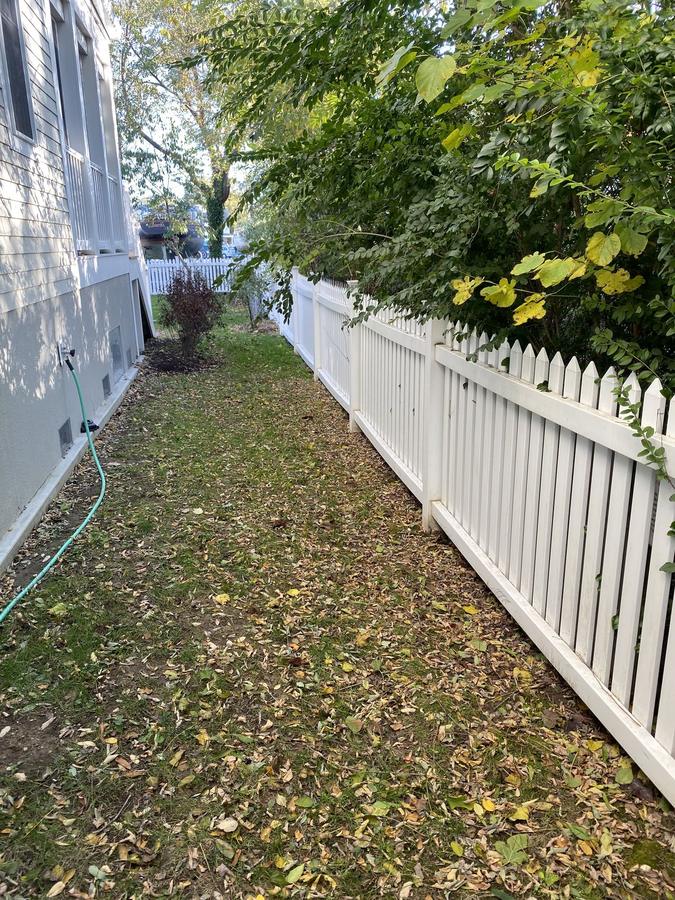
Wood (cedar or pressure-treated) gives the traditional coastal look, and a white picket fence on a waterfront lot is the local vernacular. It needs maintenance, and near salt air it needs the fastener specification taken seriously or the boards will streak with rust.
Composite aims at the wood appearance with less upkeep, at higher cost and with more weight for the posts to carry.
Before anything gets set in the ground: know where your property line actually is. A fence built over a line is the owner's problem to move, and boundaries on older coastal lots are frequently not where the hedge, the driveway or the neighbor's assumption puts them. If there is any doubt, a survey costs far less than relocating a finished fence.
What rules apply to fences here?
Fencing is one of the most locally regulated things we build, and the rules differ between the four towns and unincorporated Sussex County. In unincorporated Sussex County a new fence needs a building permit; the county lists fences among the work that requires one (county permitting requirements). Things that commonly apply:
- Height limits, usually different for front yards than for rear and side yards.
- Corner-lot sight triangles, which restrict height near intersections and driveways so drivers can see.
- Which side faces out. Many jurisdictions require the finished side to face the neighbor or the street.
- Setback from the property line and whether the fence may sit on the line itself.
- Pool barrier requirements, which are safety code rather than aesthetics and are not negotiable: height, gap dimensions, and self-closing, self-latching gates.
- HOA and community rules, which in this market are often stricter than the town's and are a separate approval from the permit. In many of the coastal communities around Bethany and Rehoboth an HOA architectural review is the real gate.
- Proximity to the beach and dune. A property near the DNREC Building Line may need a DNREC letter of approval or coastal construction permit for work in that zone, and dune areas are protected. Get the approval before anything goes in the ground in that zone.
We work this out before the fence is designed rather than after it is installed, and where a permit is required, we take care of it before work starts. The permits page covers each jurisdiction in depth.
Repair or replace?
A fence with sound posts and some failed panels or boards is a repair. Panels are replaceable and it is worth doing. A fence whose posts are leaning, rotted at grade or pulling out is effectively at the end of its life, because the posts are the structure and replacing them means taking the fence apart anyway. If you can rock a post by hand, that section is telling you which category it is in.
Fencing projects
Fencing FAQ
Why do fences lean and fail faster near the coast?
A solid privacy fence takes the full force of the wind and passes that load into the posts and then into the ground, and an open coastal lot has nothing upwind to break it. Loose sandy soil also provides less lateral resistance than dense clay, so post depth, hole diameter and how the post is set matter more here than inland.
Is a solid privacy fence a bad idea on an exposed lot?
It is a structural decision rather than only an aesthetic one. Semi-open styles such as picket, spaced board, shadowbox and aluminum let wind pass through and reduce the load the posts carry. Where full privacy is wanted on a windy lot, the answer is deeper, larger posts set closer together.
Which fence material lasts longest in salt air?
Vinyl does not rot, corrode or need refinishing, though solid vinyl privacy panels load the posts heavily on exposed lots. Aluminum suits waterfront and pool runs because it is open to wind and does not rust like steel, at the cost of privacy. Wood gives the traditional coastal look but needs maintenance and careful fastener specification. Composite trades higher cost and weight for lower upkeep.
Do I need a survey before installing a fence?
If there is any doubt about where the boundary sits, yes; a survey costs far less than relocating a finished fence.
What rules apply to fences in the Delaware beach towns?
Commonly height limits that differ between front and rear yards, corner-lot sight triangles, requirements about which side faces the neighbor or street, setback from the property line, and pool barrier requirements covering height, gaps and self-closing self-latching gates. HOA architectural review is often stricter than the town rule and is a separate approval. Properties near the DNREC Building Line may also need DNREC approval.
Can my fence be repaired instead of replaced?
A fence with sound posts and some failed panels or boards is a repair worth doing, because panels are replaceable. A fence whose posts are leaning, rotted at grade or pulling out is effectively at the end of its life, since the posts are the structure and replacing them means dismantling the fence anyway. If a post can be rocked by hand, that section needs replacing.
Planning a fence?
If you are comparing quotes, ask each contractor how deep the posts go and what hardware they spec. Then ask us. Estimates are free throughout the beach towns.